

Some crafts decorate cloth. Phulkari tells a story on it. The word itself is a promise of what you'll see — phul (flower) and kari (work): literally, "flower work." For generations across Punjab, this folk embroidery has turned ordinary handspun cloth into something a mother saves for her daughter, a bride wraps around her shoulders, and a family keeps long after the hands that made it are gone.
What exactly is phulkari?
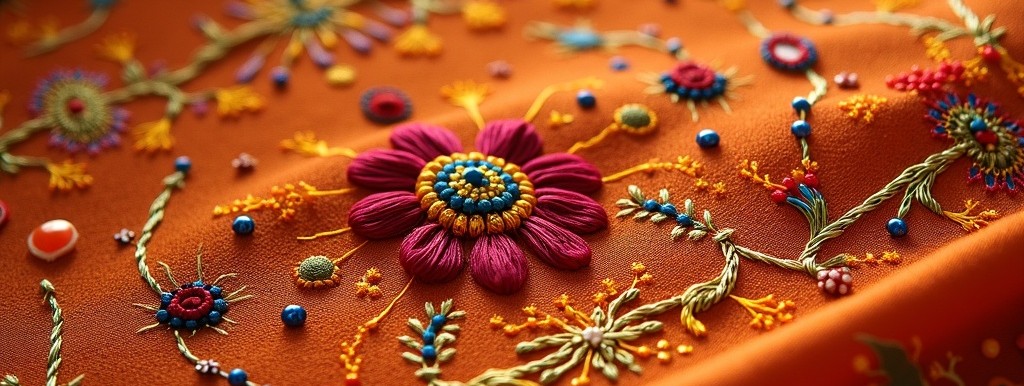
Phulkari is a traditional embroidery of the Punjab region, worked in lustrous silk floss (called pat) on a coarse, handwoven cotton base known as khaddar — usually in deep rust, indigo, or black. What makes it unique is the technique: it is stitched almost entirely with a simple darning stitch worked from the reverse side of the fabric, counting threads as the artisan goes. There is no printed pattern to follow. The design lives in the embroiderer's memory and hands.
Because the stitches are laid at different angles, the finished piece seems to shift and shimmer as light moves across it — the same motif looking bright from one direction and shadowed from another.
Bagh, sainchi and the everyday phulkari
Not all phulkari is the same, and the differences carry meaning:
- Bagh ("garden") — when the embroidery covers the base cloth so completely that the khaddar disappears entirely beneath the silk. A bagh was the most prized, often made for weddings and major occasions.
- Phulkari — the everyday form, where motifs are scattered across the cloth and the base colour still shows between them.
- Sainchi — narrative phulkari from the Malwa belt, depicting village life: farmers, animals, jewellery, even trains — a folk diary in thread.
- Chope and Suber — specific pieces tied to wedding rituals, traditionally embroidered by the bride's grandmother and worn at key moments of the ceremony.
A craft woven into life's milestones
Historically, a phulkari was begun at a girl's birth and added to over the years, so that a rich trousseau of pieces was ready by the time she married. It was never bought off a shelf — it was made for someone, stitch by stitch, often by the women of the family together. To gift a phulkari was to gift hours of someone's life and a blessing for the road ahead.
That emotional weight is why an authentic, hand-embroidered phulkari feels so different from a machine-printed imitation. One is décor. The other is inheritance.
The motifs and their meaning
The vocabulary of phulkari is drawn from the world around the artisan — wheat and barley stalks, the belan (rolling pin), karela (bitter gourd), the sun, and endless geometric flowers. These weren't random. They celebrated fertility, harvest, prosperity and the rhythms of agrarian Punjabi life. Reading an old phulkari is a little like reading the hopes of the woman who made it.
From near-disappearance to revival
Like many handcrafts, phulkari suffered as machine embroidery flooded the market with cheap lookalikes. But it has seen a strong revival — recognised today as a treasured part of Punjab's cultural identity, and increasingly sought by a new generation, including Punjabis abroad who want to keep a thread of home close. Choosing genuine phulkari also supports the artisans who keep the skill alive.
How to wear and care for phulkari today
- A phulkari dupatta instantly lifts a plain kurta or suit — let the embroidery be the hero and keep the rest simple.
- Drape one over a neutral outfit for Vaisakhi, Lohri, a wedding, or any day you want a piece of Punjab on your shoulders.
- Store it folded with the embroidery inward, away from direct sunlight, and dry-clean rather than machine-wash to protect the silk floss.
Wear a piece of the story
At PunjabiCart, our phulkari pieces are a tribute to this living art — made to be worn, gifted, and handed down. When you drape one, you're not just wearing a colour. You're carrying centuries of Punjabi women's craft, patience and blessing.
Explore our phulkari dupattas and suits, and bring home a flower garden stitched in silk.
Leave a Comment